
The gap between the barrel and the pump
For decades, investors have watched Brent and West Texas Intermediate (WTI) to judge where energy inflation is heading. That shortcut no longer works.
Consumers do not buy unprocessed barrels. They buy gasoline, diesel, jet fuel, and heating oil. The difference between the price of a barrel of crude oil and the price of the fuels refined from it is the crack spread, a rough proxy for what refiners earn for turning crude into finished product. It is only a proxy, since it excludes operating costs, the natural gas refiners burn in the process, and the actual mix of products each plant produces. Even so, it captures the part of the fuel price that crude quotes miss entirely.
The industry benchmark is the New York Mercantile Exchange (NYMEX) 3-2-1 crack spread, built on the simplified assumption that three barrels of crude oil yield two barrels of gasoline and one of diesel. When refining capacity is constrained, that spread widens, and pump prices can climb to records while crude itself goes nowhere. That is precisely what happened this year. Brent has traded near $95 a barrel and WTI near $90, broadly flat to lower since January, yet U.S. retail diesel has set an all-time high near $6 a gallon.
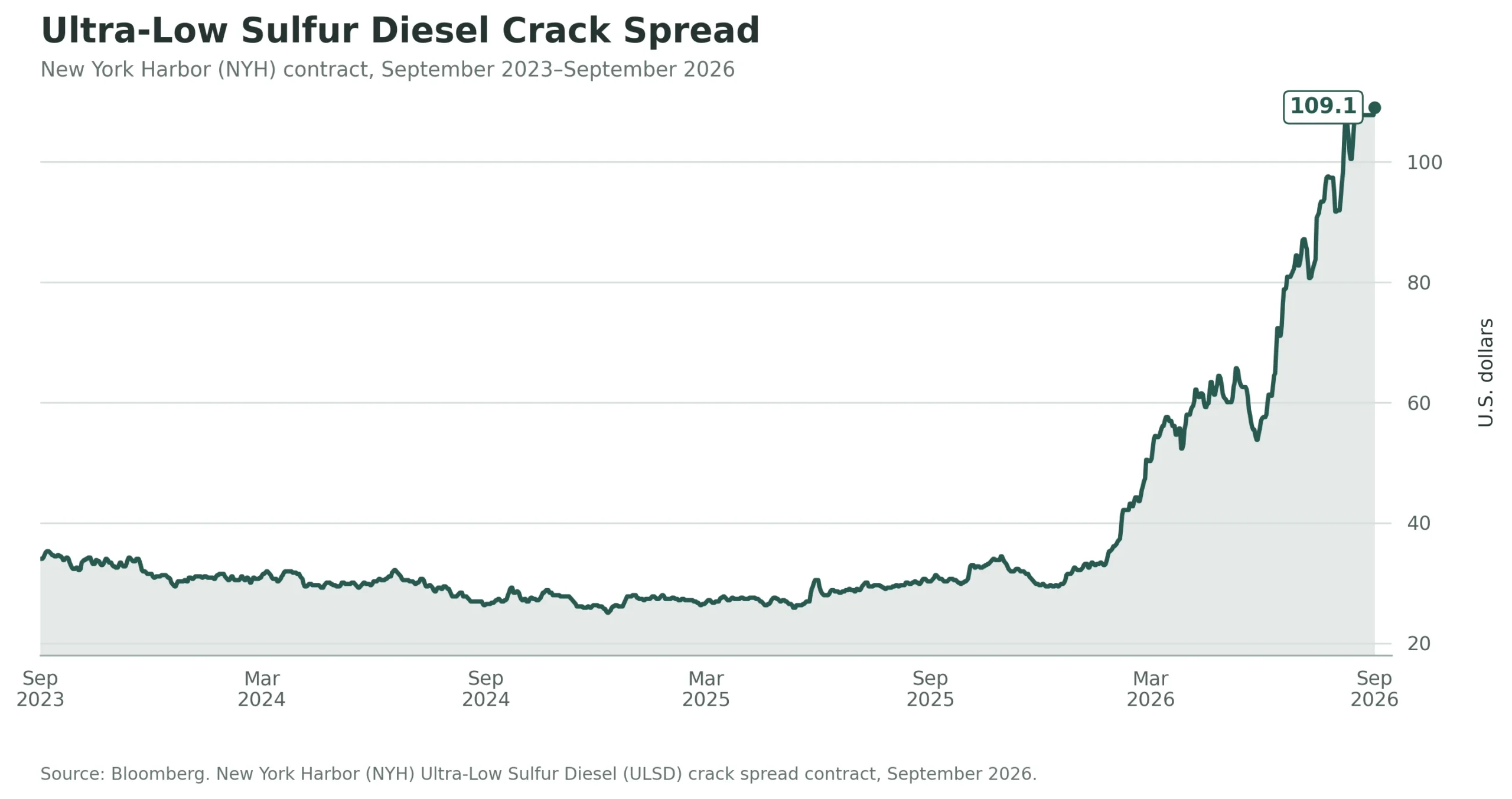
The chart below shows the New York Harbor ultra-low sulfur diesel crack spread for September 2026 delivery, the clearest single measure of the diesel squeeze.
What tightened the market
The U.S. Energy Information Administration reports that global refined-product markets have tightened as refinery outages and shipping constraints cut available supply. Three forces converged.
Conflict in the Middle East. Hostilities involving the United States, Israel, and Iran disrupted traffic through the Strait of Hormuz and damaged Persian Gulf refining assets. Fuel exports fared worse than crude. Refined products move on smaller, specialized vessels, while crude travels on a large and largely interchangeable tanker fleet, so product shipments had far less spare capacity to absorb the disruption.
Russian outages and the diesel export ban. Ukrainian drone strikes disabled a large share of Russian refining capacity. Moscow responded by banning diesel exports outright to shield the domestic market, pulling 0.8 to 1.0 million barrels per day of diesel alone out of world trade. Across all refined products, and adding the damage in the Middle East, the shortfall is far larger: Vitol Group chief executive Russell Hardy puts total lost exports at roughly 4 million barrels per day, split evenly between the two regions, according to Bloomberg.
A distillate problem above all. Middle distillates, chiefly diesel and heating oil, took the hardest hit, because the facilities knocked offline skewed toward diesel and jet fuel rather than gasoline. U.S. refiners chased the wider distillate margin and shifted their output toward it, but even that was not enough. EIA data show U.S. distillate inventories fell to 14 percent below the five-year seasonal average, the lowest seasonal level on record.
Those losses have pushed refining margins past every prior record. Bloomberg reports the U.S. diesel crack spread cleared $100 per barrel for the first time and peaked above $106, while gasoline refining margins topped $50, leaving diesel at a premium of roughly $56 per barrel over gasoline. The NYMEX 3-2-1 spread reached an all-time high of $72 per barrel, according to Dow Jones Energy. In Europe, diesel’s premium over Brent widened from $21 to $100 per barrel, lifting wholesale diesel to about $194 per barrel. European pump prices have risen further still, though roughly half of that retail figure is fuel duty and value-added tax rather than refining margin. American refineries, meanwhile, ran at 97.2 percent of capacity against a typical rate near 90 percent, according to the EIA, which leaves almost nothing in reserve should another plant go down.
The widening crack spread is showing up clearly in equity performance: year to date, the S&P 500 Oil Refiner Index has surged 132%, far outpacing the 35% gain in the S&P 500 Oil Driller and Exploration Index.
How it reaches the wider economy
The most visible effect is at the pump. The American Automobile Association puts the national average for regular gasoline at $4.29 per gallon and retail diesel at an all-time high of $6.05 as of September 11, 2026.
Diesel matters more than gasoline for the economy, because diesel moves freight, runs farm equipment, and powers industry. The trucking sector is poorly placed to absorb the increase. Roughly 95 percent of U.S. carriers operate ten trucks or fewer, according to the American Trucking Associations, and small operators cannot carry elevated fuel bills for long. Sustained pressure at these levels points toward potential carrier failures, which would shrink hauling capacity and push freight rates higher even after fuel costs recede.
From there the cost travels. Carriers and manufacturers pass higher transport expense down the chain, and it surfaces in grocery prices, retail goods, and services. Households facing a larger fuel bill and higher shelf prices at the same time pull back on everything discretionary, which is how an energy shock becomes a demand problem.
Why central banks are watching
Policymakers have begun citing crack spreads directly. Bloomberg News reports that Bank of England Governor Andrew Bailey follows widening crack spreads more closely than headline crude, on the straightforward logic that households buy refined fuel, not barrels. The European Central Bank has made a similar point, noting that constrained refining capacity and surging product spreads feed inflation expectations that crude prices alone fail to signal.
A wider crack spread will not prompt a rate increase on its own. It will, however, keep policymakers from cutting early or declaring the inflation fight finished, because refining bottlenecks push straight into the consumer price index through fuel and freight.
What this means for portfolios
Look past crude when judging inflation. Energy-driven price pressure can build while WTI and Brent sit still. The 3-2-1 crack spread and the NYH ULSD contract are quoted daily on the NYMEX and carried by any standard market data service, and they will show the stress weeks before it reaches the Consumer Price Index (CPI) print.
Expect margin pressure where freight is a large cost line. High diesel prices function as a tax on supply chains. Retail, logistics, manufacturing, and consumer discretionary names absorb it unless they have the pricing power to pass it on. That distinction, not sector labels, is what separates the companies that hold margin from those that do not.
Plan for rates to stay higher for longer. Persistent bottlenecks keep headline inflation elevated and reinforce the case for restrictive policy.
Know what would end the upward pressure on the crack spread. Four events:
- The spread narrows when Russian refining capacity comes back online.
- When the Russian diesel export ban lapses.
- When the Gulf facilities are repaired.
- When the autumn maintenance season concludes and idle capacity returns.
Watch those four and watch the weekly EIA distillate inventory number for the first sign that the rebuild has started.
Disclosure
This material was prepared by the James Investment Research team for informational purposes only. It does not constitute investment advice or a recommendation to buy or sell any security, and it does not take into account the objectives, financial situation, or needs of any particular investor. Information has been obtained from sources believed to be reliable, but its accuracy and completeness cannot be guaranteed. Views expressed reflect current conditions and are subject to change without notice. Past performance does not guarantee future results, and all investments involve risk, including possible loss of principal.